Understanding skin | Estheticians guide
The Dermis: 5 Critical Functions Your Skin Depends On

Free Shipping to Australia on orders over $100. Worldwide on Orders over $250. Dismiss
By Samantha Miller, Clinical Esthetician & Founder of The Naked Chemist | Updated: June 2026
You’ve probably heard that skincare works “at a cellular level”.
But most products never get close to where the real action happens.
Everything that determines whether your skin looks firm and hydrated or tired and reactive happens in the dermis.
This is the layer most skincare brands don’t talk about, because it’s harder to market than a serum that “glows.”
Yet almost every visible sign of ageing — lines, loss of firmness, dullness, and chronic sensitivity.
It all begins here, not on the surface.
Understanding this layer changes how you think about skincare entirely.
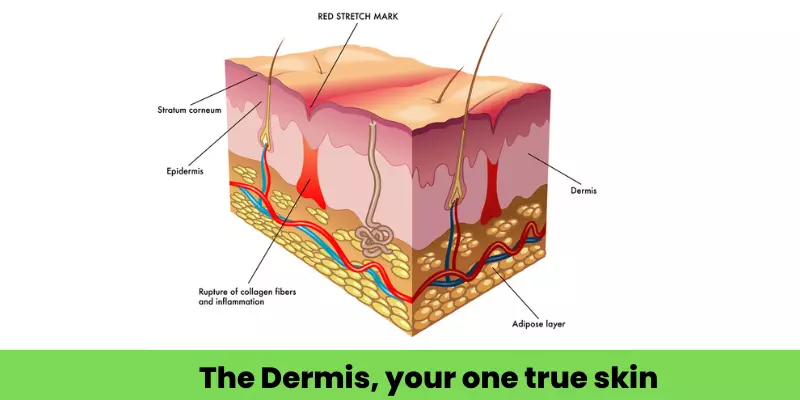
The dermis is the middle layer of skin, sitting between the epidermis above and the subcutaneous layer below. It is the thickest of the skin’s three layers and contains collagen, elastin, blood vessels, nerve endings, sebaceous glands and sweat glands — making it the structural and functional engine of the skin. Most visible signs of ageing, including loss of firmness and deep hydration, originate in the dermis.
The dermis is one of the three layers of skin. This guide focuses on the dermis itself — what it is, what lives inside it, and how to support it.
Key takeaways
The dermis is the middle layer of skin, positioned directly beneath the epidermis and above the subcutaneous layer. It is often called the “true skin” or “living layer” because it holds the structures that give skin its strength, flexibility, sensation and ability to heal.
The epidermis gets all the attention — it’s the surface we exfoliate and moisturise — but it’s relatively thin and largely made up of dead cells being shed. The dermis is where the real work happens. Think of the epidermis as the paint on a wall, and the dermis as the wall itself. No amount of surface treatment fixes a crumbling structure underneath.
This is why barrier-first skincare matters so much. When the epidermis is chronically disrupted — by over-exfoliation, harsh products or inflammation — the dermis takes the hit, and that damage is far harder to reverse than surface damage.
The dermis is divided into two distinct layers: the papillary layer (upper) and the reticular layer (deeper). Each has a specific structure and function, but together they form the complete support system of the skin.
The papillary layer sits directly beneath the epidermis. It’s made of loose connective tissue dotted with tiny projections called papillae — finger-like extensions that reach up into the epidermis. These papillae do two important things: they create the fingerprint patterns unique to each person, and they house the sensory receptors (including Meissner’s corpuscles) that detect light touch and pressure.
The papillary layer is also where the first signs of ageing become visible. As collagen here thins with age, the bond between this layer and the epidermis weakens — contributing to the crepey, papery texture that no topical cream can fully reverse.
Below the papillary layer lies the reticular layer — a dense network of collagen and elastic fibres that forms the structural backbone of the skin. This is the thicker of the two layers, and it’s where most of the skin’s major structures are housed: blood vessels, sebaceous glands, sweat glands, hair follicles and nerve endings. It is, in every sense, the engine room of the skin.
Collagen and elastin are the two structural proteins that give the dermis — and therefore the skin — its firmness and flexibility. Collagen provides structure and tensile strength; elastin provides the snapback. Together, they form an internal scaffolding that keeps the skin taut, plump, and resilient.
Both are encased in glycosaminoglycans (GAGs) — a gel-like fluid that keeps the dermis hydrated and cushioned. The most important GAG in skincare is hyaluronic acid, which can bind up to 1,000 times its weight in water.
Here’s the part that surprises most people: collagen production starts declining in your mid-20s, by roughly 1% per year. By the time you notice visible ageing, you’ve already lost significant collagen — which is why prevention matters far more than correction. UV exposure accelerates collagen breakdown significantly, so one of the most protective things you can do costs almost nothing: applying SPF daily.
Recommended:H2OHydrating Skin Shot
The dermis is where hyaluronic acid and the skin’s deep hydration live. H2O delivers humectant hydration to support the skin’s moisture environment — helping skin feel plumper, calmer and more resilient day to day.
Best for: dehydrated, tight or dull skin that needs consistent hydration support.
Sebaceous glands produce sebum — your skin’s natural oil — which travels up through hair follicles to the surface. Sebum isn’t the enemy: it’s your skin’s built-in moisturiser, keeping the epidermis lubricated, preventing moisture loss and maintaining the acid mantle.
This is where so many routines go wrong. Stripping sebum with harsh cleansers or alcohol-based toners signals the glands to produce more, leaving skin oily yet dehydrated — a state that feels impossible to balance. The dermis also contains sudoriferous (sweat) glands, which regulate temperature and help excrete waste; these are separate from sebaceous glands and serve a different function.
The dermis is your skin’s sensory gateway. A dense network of nerve endings runs through both sub-layers, allowing the skin to detect touch, pressure, pain, heat, and cold and relay them to the brain in milliseconds.
This is why reactive skin feels so uncomfortable. When the dermis becomes chronically inflamed — from a compromised barrier, harsh actives, or environmental triggers — nerve sensitivity increases, and skin that was once tolerant starts reacting to products it previously tolerated. Chronic inflammation is a cycle: inflammation damages collagen, damaged collagen weakens the barrier, and a weakened barrier triggers more inflammation. Breaking the cycle means calming the dermis, not piling more actives onto the surface.
Recommended: Xcell Skin Shot
The dermis can only recover when the barrier above it is intact. Xcell supports the skin’s barrier by replenishing lipids — helping calm inflammation and providing the dermis with the stable, protected environment it needs to rebuild.
Best for: compromised, reactive or sensitised skin where the barrier needs rebuilding.
Most damage isn’t caused by neglect — it’s caused by over-treatment. The clients I see in clinic with the most compromised skin are almost always the ones who’ve tried hardest with the wrong products.
Aggressive exfoliation removes the protective barrier faster than it can rebuild. Without it intact, environmental stressors, UV, and topical actives penetrate deeper and trigger inflammation, which, over time, accelerates collagen breakdown. Once or twice a week is enough for most skin types.
Strong retinoids, high-percentage acids, and aggressive vitamin C can penetrate beyond the epidermis and provoke an inflammatory response in the dermis before the skin is ready. This is often misread as “purging” when it’s actually irritation at a structural level. Start low, build slowly — the dermis responds to consistency, not intensity.
UV radiation is the single biggest external cause of dermal collagen breakdown, generating free radicals that directly damage collagen and elastin fibres. Daily SPF is the most evidence-backed anti-ageing step in any routine — nothing else comes close.
If your skin is losing firmness, struggling to hold moisture, or reacting to products it once tolerated, the issue isn’t at the surface — it’s deeper. A chronically disrupted barrier slowly exhausts the dermis, triggering the inflammation that breaks down collagen. At The Naked Chemist, we formulate with this layer in mind: barrier integrity first, so the dermis gets the stable environment it needs to rebuild, retain moisture and maintain the structural proteins that keep skin looking healthy.
The dermis is one of the three layers of skin that skincare brands rarely talk about — but it’s where every meaningful change in your skin begins. Collagen, elastin, hydration, nerve sensitivity, oil production: all of it originates here, in the living layer beneath what you can see.
Most people spend years treating the surface and wondering why the results never last. They don’t last because surface treatment alone can’t fix structural decline. Supporting the dermis — through barrier repair, consistent SPF and ingredients that work at depth — is the difference between chasing results and achieving them.
Your skin isn’t failing you. Give it the right environment, and it will do its job remarkably well. The dermis doesn’t need fighting. It needs supporting — and now you know how.
The dermis is the middle layer of skin, between the epidermis above and the subcutaneous layer below. It’s the thickest skin layer and contains collagen, elastin, blood vessels, nerve endings, sebaceous glands and sweat glands — making it the structural and functional core of the skin.
It’s made of collagen and elastin (structural proteins), glycosaminoglycans including hyaluronic acid (which holds water), plus blood vessels, nerve endings, sebaceous glands, sweat glands and hair follicles — organised into two sub-layers, the papillary and reticular.
The dermis sits between the epidermis (the outer visible layer) and the subcutaneous layer (the deepest fatty layer). It makes up roughly 90% of the skin’s thickness and is significantly thicker on the back than on the eyelids.
Most topical skincare works at the epidermal level. Hyaluronic acid hydrates the surface and upper layers; peptides and certain retinoids can signal changes at the dermal level. Very few molecules are small enough to reach the dermis directly, and those that do need to be introduced slowly to avoid irritation.
The main causes are UV exposure (which breaks down collagen), chronic inflammation (which disrupts structural proteins), smoking (which impairs blood flow) and repeated physical stress. A chronically compromised skin barrier also lets inflammatory triggers penetrate more deeply, causing cumulative damage over time.
To a degree, yes. The dermis keeps fibroblasts throughout life, which produce collagen and elastin. Retinoids, vitamin C and certain peptides can stimulate fibroblast activity, and treatments like radiofrequency promote collagen production. But prevention — daily SPF and barrier support — is far more effective than correction.